Pay Off Student Loan Interest While in School: Why It Matters

If possible, paying just the interest on your loans each month while you’re still in school is one of the most underused ways to graduate with meaningfully less student debt — not because it eliminates the loan, but because of how unpaid interest gets handled once repayment begins.

First, know which loans this actually applies to

As covered in the federal vs. private loans post earlier in this series, not all loans accrue interest the same way while you’re enrolled:

Continue reading “Pay Off Student Loan Interest While in School: Why It Matters”
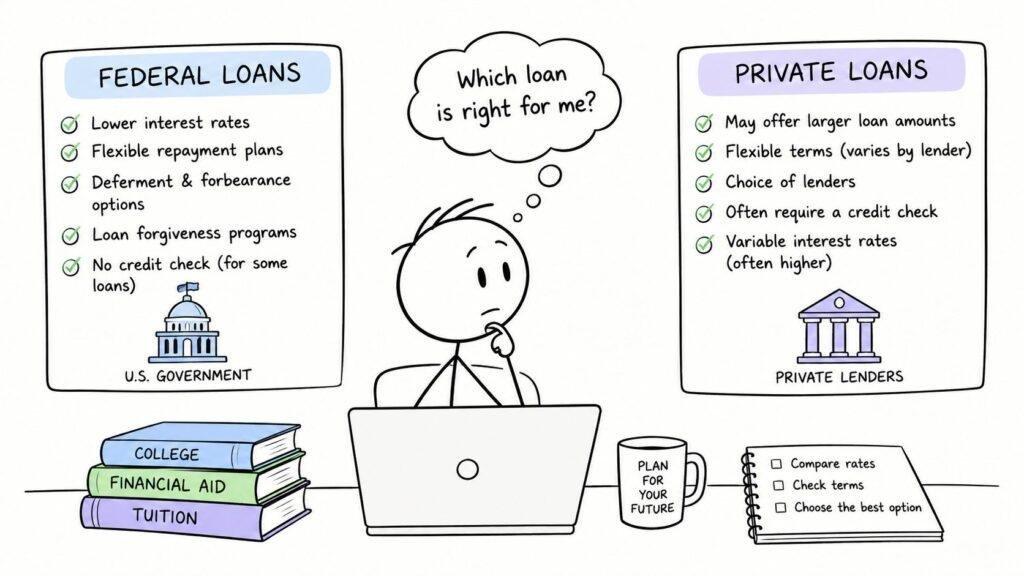

Federal vs. Private Student Loans: What’s the Difference?

There are different rules for federal loans versus private loans, and treating them as basically interchangeable — “a loan is a loan” — is one of the more costly assumptions a student can make. The two categories are structured differently enough that the choice between them can meaningfully affect what you owe and how much flexibility you have if things don’t go as planned after graduation.

Student comparing federal and private student loans for college

As with the loans and financial aid research post earlier in this series, this isn’t financial advice about which to choose — rates, terms, and specific programs change, and your right choice depends on your specific situation. What follows are the actual dimensions worth understanding, and where to check the current details for yourself: Federal Student Aid (studentaid.gov) for anything federal, and the Consumer Financial Protection Bureau (consumerfinance.gov) for plain-language explanations of borrower rights and private lending practices.

Continue reading “Federal vs. Private Student Loans: What’s the Difference?”

How to Find and Apply for College Scholarships

You’ve probably heard some version of this before: billions of dollars in scholarships go unclaimed every year, just sitting there waiting for someone to apply. It’s a compelling idea — that paying for college is partly a matter of finding money nobody else bothered to look for. It’s also, mostly, a myth, and it’s worth clearing up before getting into what’s actually true and actually worth your time.

College student searching for scholarships and preparing an application.
Continue reading “How to Find and Apply for College Scholarships”

Student Loans and Financial Aid: What College Students Need to Know

Don’t underestimate the complexity of the loan and financial aid portion of your college research. It’s easy to treat this step as a formality — fill out a form, accept whatever aid package shows up, move on — but this is genuinely one of the most consequential financial decisions a student makes, and it deserves real research time, not a quick skim.

College student learning about student loans and financial aid options

A quick note before anything else: this post isn’t financial advice, and it won’t tell you which loan or aid package to choose — that decision depends on your specific numbers, your school, and your situation, and it deserves a real conversation with your school’s financial aid office, not a generic recommendation from a blog. What this post can do is help you find the right places to look, and ask the right questions once you’re there.

Continue reading “Student Loans and Financial Aid: What College Students Need to Know”

Community College: An Affordable Way to Get Started in Higher Education

If you’re on a tight budget or still deciding on a major, starting at a local community college before moving to a four-year school is one of the largest, most legitimate ways to cut the total cost of a degree — not a compromise, and not a lesser path, just a different order of operations that can save a serious amount of money.

Student attending community college as an affordable way to start higher education

The actual numbers

Recent tuition data puts average annual tuition and fees at public two-year colleges at roughly $4,000-$4,150, compared to around $11,600 at public four-year in-state universities — nearly three times higher. Spread across two years of general and prerequisite courses, that gap alone typically works out to $15,000-$30,000 in tuition savings before factoring in anything else.

Continue reading “Community College: An Affordable Way to Get Started in Higher Education”

Know Your Financial Direction: How to Set Goals and Manage Your Money

Every post in this series so far has been about managing money you’ve already committed to spending — tracking it, protecting it, deciding where it goes. This one is different. It’s about avoiding a cost so large that it can outweigh every other saving tip in this entire series combined: an extra, unplanned semester or year of college.

College student planning financial goals and finding a clear direction

Why this trap is so easy to fall into

Only a minority of students at four-year schools actually graduate in four years — most recent data puts on-time completion at roughly 40-44% nationally. That means the majority of students end up paying for at least one semester, often a full extra year, that a well-planned schedule could have avoided entirely.

Continue reading “Know Your Financial Direction: How to Set Goals and Manage Your Money”

Develop Better Spending Habits: Simple Ways to Manage Your Money

A friend’s car breaks down the week before finals, and she needs $200 to get it fixed or she can’t get to her exam. A weekend trip comes up out of nowhere — cheap flights, a free place to stay, an actual chance to go somewhere with people you care about, if you can cover your share by Thursday. A part-time job cuts your hours unexpectedly for a month, and rent is still due on the first.

None of these moments care whether you’re ready for them. What decides whether they become a stressful scramble or just a normal Tuesday is whether there’s already money sitting there, waiting to be useful, because of choices made weeks or months earlier.

Building good spending habits through financial discipline

That’s what good spending habits actually buy you. Not restriction. Freedom of choice — the freedom to say yes when something actually matters, because you didn’t say yes to everything along the way.

Continue reading “Develop Better Spending Habits: Simple Ways to Manage Your Money”

Why You Should Review Your Bank and Credit Card Statements Monthly

Sticking to a budget isn’t just about planning ahead — it’s also about checking, after the fact, that what actually happened matches what you expected. That’s what a monthly statement review is for. It’s one of the least exciting habits in personal finance, and also one of the most protective, for two separate reasons: it keeps your budget honest, and it’s your main defense against fraud.

Person reviewing bank and credit card statements each month.
Continue reading “Why You Should Review Your Bank and Credit Card Statements Monthly”

How to Stop Impulse Buying: Simple Ways to Spend Less and Save More

It’s easy to get caught up in the moment. A delivery app notification during a late-night study session. An ad that hits right after a stressful exam. A group chat where everyone’s ordering the same hoodie. None of these purchases feel reckless in the moment — they feel small, reasonable, easy to justify. That’s exactly what makes impulse buying so effective at draining a budget without ever feeling like the problem.

Person avoiding impulse buying and making smarter spending decisions

The real cost of “it’s just a small purchase”

A single $6 coffee run doesn’t feel like a budget threat. But three impulse coffee runs a week, for a 15-week semester, adds up to roughly $270 — money that was never planned for, never showed up in a budget category, and quietly disappeared anyway.

Continue reading “How to Stop Impulse Buying: Simple Ways to Spend Less and Save More”

The College Student Money Lifestyle: How to Budget, Save, and Spend Wisely

Frugality and finding free opportunities is money smart. Not because being careful with money is a personality you need to adopt forever, but because right now, in college, it’s the single highest-leverage financial move available to you — and it won’t always be.

College student managing money and following a smart financial lifestyle

That distinction matters. Once you’re established in a career, you’ll be in a much better position to make different choices — eating out more, upgrading things sooner, spending less time hunting for the free version of something. College frugality isn’t a life sentence. It’s a phase that matches where you actually are right now: income is limited, expenses are front-loaded, and — this is the part people miss — you have access to an unusual number of free and discounted resources that disappear the moment you graduate.

Continue reading “The College Student Money Lifestyle: How to Budget, Save, and Spend Wisely”