Do your research thoroughly before signing anything. Off-campus renting can be cheaper than a dorm in some situations, and more expensive in others — the only way to know which applies to you is to actually add up the full cost, not just compare the advertised monthly rent to your dorm’s price tag.
A Resident Assistant, commonly called an RA, is a student who lives in a dorm and takes on a peer leadership and support role for the other residents on their floor or in their building — helping with everything from move-in logistics to conflict between roommates to being an on-call point of contact during emergencies. It’s a real job with real responsibilities, but the compensation attached to it makes it one of the most financially significant options covered anywhere in this series.
The “traditional” college experience — moving into a dorm, living on campus, the full-time residential experience — isn’t for everyone, and it isn’t required to get a real degree. If a local school is a genuine option, living at home for a while, even just the first year or two, is one of the largest single savings available to a student, on the same scale as the community college strategy covered earlier in this series — just applied to housing instead of tuition.
If possible, paying just the interest on your loans each month while you’re still in school is one of the most underused ways to graduate with meaningfully less student debt — not because it eliminates the loan, but because of how unpaid interest gets handled once repayment begins.
First, know which loans this actually applies to
As covered in the federal vs. private loans post earlier in this series, not all loans accrue interest the same way while you’re enrolled:
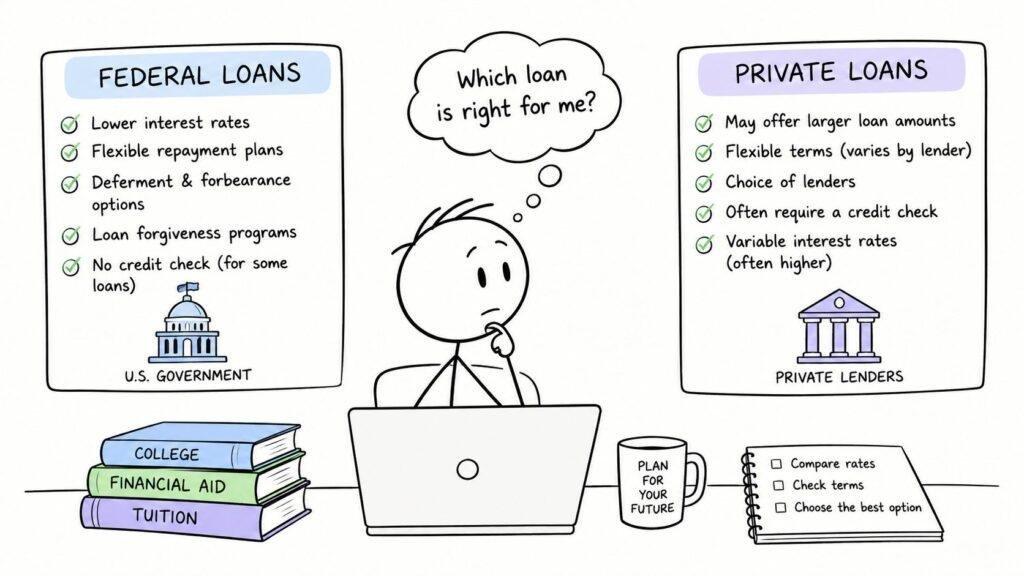
There are different rules for federal loans versus private loans, and treating them as basically interchangeable — “a loan is a loan” — is one of the more costly assumptions a student can make. The two categories are structured differently enough that the choice between them can meaningfully affect what you owe and how much flexibility you have if things don’t go as planned after graduation.
As with the loans and financial aid research post earlier in this series, this isn’t financial advice about which to choose — rates, terms, and specific programs change, and your right choice depends on your specific situation. What follows are the actual dimensions worth understanding, and where to check the current details for yourself: Federal Student Aid (studentaid.gov) for anything federal, and the Consumer Financial Protection Bureau (consumerfinance.gov) for plain-language explanations of borrower rights and private lending practices.
You’ve probably heard some version of this before: billions of dollars in scholarships go unclaimed every year, just sitting there waiting for someone to apply. It’s a compelling idea — that paying for college is partly a matter of finding money nobody else bothered to look for. It’s also, mostly, a myth, and it’s worth clearing up before getting into what’s actually true and actually worth your time.
Don’t underestimate the complexity of the loan and financial aid portion of your college research. It’s easy to treat this step as a formality — fill out a form, accept whatever aid package shows up, move on — but this is genuinely one of the most consequential financial decisions a student makes, and it deserves real research time, not a quick skim.
A quick note before anything else: this post isn’t financial advice, and it won’t tell you which loan or aid package to choose — that decision depends on your specific numbers, your school, and your situation, and it deserves a real conversation with your school’s financial aid office, not a generic recommendation from a blog. What this post can do is help you find the right places to look, and ask the right questions once you’re there.
If you’re on a tight budget or still deciding on a major, starting at a local community college before moving to a four-year school is one of the largest, most legitimate ways to cut the total cost of a degree — not a compromise, and not a lesser path, just a different order of operations that can save a serious amount of money.
The actual numbers
Recent tuition data puts average annual tuition and fees at public two-year colleges at roughly $4,000-$4,150, compared to around $11,600 at public four-year in-state universities — nearly three times higher. Spread across two years of general and prerequisite courses, that gap alone typically works out to $15,000-$30,000 in tuition savings before factoring in anything else.
Every post in this series so far has been about managing money you’ve already committed to spending — tracking it, protecting it, deciding where it goes. This one is different. It’s about avoiding a cost so large that it can outweigh every other saving tip in this entire series combined: an extra, unplanned semester or year of college.
Why this trap is so easy to fall into
Only a minority of students at four-year schools actually graduate in four years — most recent data puts on-time completion at roughly 40-44% nationally. That means the majority of students end up paying for at least one semester, often a full extra year, that a well-planned schedule could have avoided entirely.