There are different rules for federal loans versus private loans, and treating them as basically interchangeable — “a loan is a loan” — is one of the more costly assumptions a student can make. The two categories are structured differently enough that the choice between them can meaningfully affect what you owe and how much flexibility you have if things don’t go as planned after graduation.
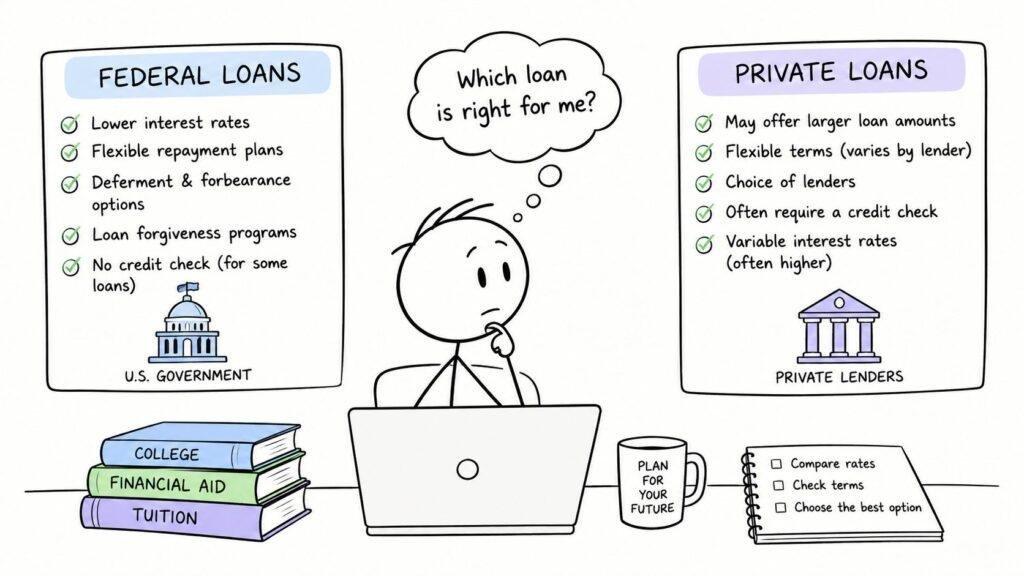
As with the loans and financial aid research post earlier in this series, this isn’t financial advice about which to choose — rates, terms, and specific programs change, and your right choice depends on your specific situation. What follows are the actual dimensions worth understanding, and where to check the current details for yourself: Federal Student Aid (studentaid.gov) for anything federal, and the Consumer Financial Protection Bureau (consumerfinance.gov) for plain-language explanations of borrower rights and private lending practices.
Where the money comes from
Federal loans are issued by the U.S. Department of Education, funded through the FAFSA process. Private loans are issued by banks, credit unions, or private lending companies, applied for directly through the lender rather than through your school’s federal aid process. This distinction is the root of most of the differences below — federal loans come with borrower protections built in by law, while private loans are governed by the individual lender’s own terms and policies.
The dimensions that actually matter
How the interest rate is set. Federal loan rates are set annually by law and are the same for every borrower with that loan type, regardless of credit history. Private loan rates depend on the lender’s own underwriting — typically your (or a cosigner’s) credit history — and can be fixed or variable. This means two students with identical private loans from the same lender can end up with different rates, while federal loan rates don’t vary by borrower.
Whether a cosigner is required. Federal loans generally don’t require one. Private loans often do, especially for undergraduate students without an established credit history — which also means a cosigner’s credit is on the line, not just the student’s.
Repayment flexibility if things go wrong. This is where the gap is often largest. Federal loans come with legally established options like income-driven repayment plans (which adjust your payment based on what you earn), deferment and forbearance options during hardship, and various loan forgiveness programs for specific circumstances. Private loans may offer some hardship options, but they’re set by the individual lender, not guaranteed by law, and vary considerably — some offer real flexibility, others very little.
When interest starts accruing. Some federal loans (subsidized) don’t accrue interest while you’re enrolled at least half-time; others (unsubsidized) do. Private loans generally start accruing interest immediately, regardless of enrollment status, though specific policies vary by lender.
What happens if the borrower can’t be reached, or in the event of death or permanent disability. Federal loans have standardized discharge provisions for these situations. Private loan policies vary significantly by lender — some offer similar protections, others place the obligation on a cosigner. This is a genuinely important detail to check directly with any private lender before a cosigner (often a parent) signs on.
Why the order of operations matters
Because of the protections above, most financial aid offices and consumer protection resources point students toward exhausting federal aid options — including federal loans — before turning to private loans to cover any remaining gap. This isn’t a rule that federal is always cheaper (private loan rates can sometimes be lower for borrowers with strong credit), but it does mean federal loans generally carry less risk if your financial situation changes unexpectedly after graduation, which is difficult to predict this far in advance.
Questions worth asking before taking a private loan
If a gap remains after federal aid, financial aid office, and scholarship research, and a private loan is genuinely part of the plan, bring these specific questions to the lender directly:
- Is the interest rate fixed or variable, and how much could a variable rate realistically change over the life of the loan?
- Does interest accrue while I’m still in school, and is there an option to pay it during that time to avoid it compounding?
- What hardship options exist if I can’t make a payment after graduation — and are they guaranteed, or discretionary on the lender’s part?
- If a cosigner is involved, what happens to their credit and obligation if I can’t pay, and is there a cosigner release option after a period of on-time payments?
- Are there any fees — origination fees, prepayment penalties — beyond the interest rate itself?
Check the current details directly
Rates, specific program terms, and available protections change over time on both the federal and private side. Rather than relying on any single article — including this one — to have the most current numbers, Federal Student Aid and the Consumer Financial Protection Bureau are the two places to check for what’s actually true right now, before signing anything.