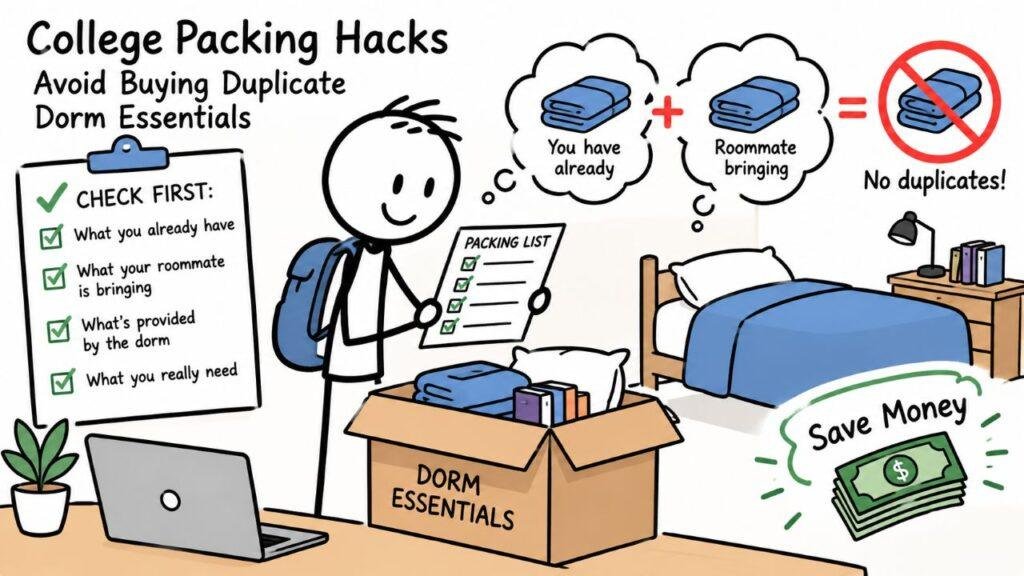
Good communication can save you real money before you’ve even moved in. The last post covered checking what your school already provides. This one covers the other half of the same problem: what happens when you and your roommate both show up with your own mini fridge, your own microwave, and your own set of pots and pans, because nobody talked about it first.
Have this conversation before move-in, not after
The entire value of this strategy depends on timing. A conversation about who’s buying what is genuinely useful the week before move-in. The same conversation, held after two mini fridges are already sitting in a room built for one, mostly just becomes an argument about who has to return theirs.
A simple group chat before move-in — even just “hey, let’s figure out who’s bringing what so we’re not doubling up” — is enough to start it. Most roommates are relieved someone brought it up first; nobody wants to be the one who bought a fridge nobody needed.
What’s actually worth sharing
Not everything should be shared — some things are personal enough (bedding, clothing, toiletries) that splitting them doesn’t make sense. The items worth coordinating on are the bigger, one-per-room items:
- Mini fridge — one is almost always enough for a standard dorm room
- Microwave, if your dorm allows personal ones and doesn’t already provide one
- TV or monitor for shared use, if anyone’s bringing one
- Basic cookware (if you have any kitchen access) — pots, pans, a kettle
- Cleaning supplies — a shared broom, vacuum, or cleaning spray doesn’t need to be duplicated per person
- WiFi router or extender, if your dorm’s connection is weak and you’re considering your own
- First aid basics — a single shared kit covers a room, rather than everyone buying their own
A simple way to split the cost
“Share the costs” is the right instinct, but it helps to agree on the method upfront, before money’s already spent:
Option 1 — Split evenly, upfront. Add up what’s needed, divide by the number of people sharing the room, and each person contributes their share before buying anything. Simple, and avoids anyone fronting money they’re not sure they’ll get back.
Option 2 — One person buys, everyone reimburses. Works well for a small number of items, but requires someone to actually follow through on paying their share — worth a quick, direct conversation about timing (“I’ll buy the fridge today, can everyone send their share by Friday?”) rather than leaving it open-ended.
Option 3 — Divide by item. One roommate buys the fridge, another buys the microwave, roughly balancing out the total cost without anyone handling a joint purchase or reimbursement at all. Often the simplest option if the items are similar in cost.
Whichever method you use, a shared note or a simple group chat message listing who bought what and for how much avoids confusion later — especially if a disagreement comes up at the end of the year.
What happens at the end
This is worth agreeing on early too, not just assumed: if one roommate bought the fridge, does it leave with them at the end of the year, get sold and split, or get left for the next occupant? A quick agreement at the start — even something as simple as “whoever bought it keeps it, unless we agree to split the resale” — avoids an awkward conversation during finals week when nobody wants to deal with it.
If a roommate situation changes mid-year — someone moves out, a new person moves in — the same principle applies: agree on how shared items get handled before it becomes a problem, not after.
The actual value here isn’t just the money
Beyond the direct savings — avoiding a second $60 fridge or a duplicate microwave — this kind of upfront conversation tends to set a better tone for the rest of the shared living situation. Roommates who talk through money and shared items early, directly and without awkwardness, generally handle other shared-living friction (chores, guests, noise) better too. The savings are real, but the habit of clear communication it builds is arguably worth just as much.